




| type | standard | form | application | nomen | number | description | picture |
|---|---|---|---|---|---|---|---|
| HostBridge | Tsi110 | The Tundra Tsi110™ is designed for use with PowerPC® processors from IBM and Freescale. The device builds on Tundra’s extensive experience in host bridging, in particular the Tsi108 and Tsi109. It delivers cost-effective performance for customers in the consumer appliance market for applications like video surveillance, video/IP, set-top boxes, and printers. The Tsi110 is also ideal for entry-level communications, storage, and industrial applications. | ![]() |
||||
| HostBridge | Tsi109 | The Tundra Tsi109™ is an evolution of the industry leading Tsi108 advanced host bridge for PowerPC® processors. In addition to standard Tsi108 features -- PCI-X, DDR2-400 SDRAM, Gigabit Ethernet, and Flash -- the Tsi108, the Tsi109 supports dual CPU operation, boasts an improved memory pipeline, offers integrated power management and industrial temperature operation. The Tsi109 is also pin and software compatible with the Tsi108 for those who want to boost performance in existing designs. | ![]() |
||||
| HostBridge | Tsi108 | The Tundra Tsi108™ is an advanced host bridge for PowerPC® processors that supports PCI-X, DDR2-400 SDRAM, Gigabit Ethernet, and Flash. The device contains numerous integrated features that enable customers to reduce system design complexity and system costs. As a result, the Tsi108 has the best price/benefits ratio on the market. | ![]() |
||||
| HostBridge | Tsi107 | The Tundra Tsi107™ host bridge for PowerPC® provides system interconnect between PowerPC processors, PCI peripherals, and local memory. The Processor Interface supports Freescale and IBM PowerPC processors at frequencies up to 133 MHz. The device also supports a wide variety of system configurations by providing support for a second processor and a local slave device. | ![]() |
||||
| HostBridge | PowerSpan II | The Tundra PowerSpan™ II is a multi-port PCI bus switch that bridges PCI to the PowerQUICC™ II (MPC8260), MPC7xx, PowerPC® 7xx, and the Wintegra WinPath™ processors. PowerSpan II is available in either a single PCI or dual PCI variant. The device defines a new level of PCI bus switch flexibility. | ![]() |
||||
| HostBridge | QSpan II | The Tundra QSpan™ II is an industry-proven, Freescale Semiconductor processor-to-PCI system interconnect device. The QSpan II enables board designers to bring PCI-based embedded products to market faster, for less cost, and with high performance. | ![]() |
||||
| HostBridge | PowerPro | The PowerPro™ delivers memory control support for PowerPC® processors (MPC750, MPC740, MPC85xx) and the Tundra PowerPC-to-PCI bus switch, PowerSpan™. The PowerPro is designed for applications to leverage the switched PCI architecture of PowerSpan in PowerPC applications. | ![]() |
||||
| HT-Bridge | Tsi308 | The Tundra Tsi308™ is a HyperTransport™-to-PCI/X bridge designed for cost and power sensitive MIPS processor applications in communications, networking, and entry-level storage systems. | ![]() |
||||
| PCIeBridge | Tsi384 | The Tsi384™ is a high-performance forward bridge that connects the PCI Express (PCIe) protocol to the PCI and PCI-X bus standards. The Tsi384’s PCIe Interface supports 1, 2, or 4 lanes. This enables the bridge to offer exceptional throughput performance up to 1 GBps. | ![]() |
||||
| PCIeBridge | Tsi382 | The Tsi382™ is a small form-factor, high performance forward bridge that connects a single lane PCI Express (x1 PCIe) interface to the PCI bus standard. The Tsi382’s PCIe Interface is compliant to the PCI Express Specification (Revision 1.1). The device’s 32 bit PCI Interface can operate up to 66 MHz in PCI mode. This interface offers designers extensive flexibility by supporting three types of addressing modes: transparent, opaque, and non-transparent. |
![]() |
||||
| PCIeBridge | Tsi381 | The Tsi381™ is a high-performance forward bridge that connects a single lane PCI Express (x1 PCIe) interface to the PCI bus standard. The Tsi381’s PCIe Interface is fully compliant to the PCI Express Specification (Revision 1.1). The device’s 32 bit PCI Interface can operate up to 66 MHz in PCI mode. This interface offers designers extensive flexibility by supporting three types of addressing modes: transparent, opaque, and non-transparent. |
![]() |
||||
| PCIBridge | Tsi352 | The Tundra Tsi352™ is an industry-standard 32-bit 66-MHz synchronous PCI-to-PCI bridge available in eutectic or RoHS compliant 160-pin PQFP packages. The Tsi352 is a competitively priced, low-power device that can be used on existing board footprints using standard 32-bit 66-MHz PCI-to-PCI bridges from Intel, Pericom, PLX, and TI. Fully compatible with the PCI Local Bus Specification (Revision 2.3), the Tsi352 supports two PCI buses operating concurrently with sufficient clock and arbitration pins to support four PCI bus master devices directly on its secondary interface. |
![]() |
||||
| PCIBridge | Tsi350A | The Tundra Tsi350A™ is an industry standard 32-bit 66-MHz asynchronous PCI-to-PCI bridge available in eutectic or RoHS compliant 208-pin PQFP and 256 BGA packages. The Tsi350A is a competitively priced, low-power device that can be used on existing board footprints using standard 32-bit 66-MHz PCI-to-PCI bridges from Pericom, PLX, and TI. Fully compatible with the PCI Local Bus Specification (Revision 2.3), the Tsi350A supports two PCI buses operating concurrently with sufficient clock and arbitration pins to support nine PCI bus master devices directly on its secondary interface. |
![]() |
||||
| PCIBridge | Tsi340 | The Tundra Tsi340™ is an industry-standard 32-bit, 66-MHz synchronous PCI-to-PCI bridge available in a RoHS compliant, 128-pin PQFP package. The Tsi340 is a high-quality, small form-factor, low-power device backed by Tundra’s world-class service and support. The device can be used on existing board footprints using 128-pin PQFP PCI-to-PCI bridges as a competitively priced alternative. Fully compatible with the PCI Local Bus Specification (Revision 2.3), the Tsi340 supports two PCI buses operating concurrently with sufficient clock and arbitration pins to support four PCI bus master devices directly on its secondary interface. |
![]() |
||||
| PCIBridge | Tsi310 | The Tundra Tsi310™ PCI/X bridge is the industry standard, 64-bit, 133-MHz PCI-X to PCI-X bridge. The device's interfaces can be independently configured to operate in PCI or PCI-X mode allowing for efficient, hierarchical expansion of I/O bus structures. The Tsi310 feature set supports applications with embedded subsystems on the secondary bus of the bridge. The evolutionary PCI-X I/O technology increases system performance with greater throughput and efficiency. It provides up to eight times more speed than PCI bus technology, and delivers the high performance required for enterprise, telecommunications, and data communications systems. The Tsi310 transparently connects two electrically separate PCI-X bus domains, allowing concurrent operations on both buses. This results in good utilization of the buses in various system configurations and enables hierarchical expansion of I/O bus structures. The Tsi310 can handle 64-bit data at a maximum bus frequency of 133 MHz (depending upon the bus topology and load), and is backward compatible with all 3.3V I/O PCI interfaces. The Tsi310 also provides extensive buffering and prefetching mechanisms for efficient transfer of data through the device, facilitating multi-threaded operation, and high system throughput. |
![]() |
||||
| PowerControl | Tsi257 | The Tundra Tsi257™ is a secondary side power controller. It provides a large degree of control and monitoring capability for power supplies found in numerous communication, server, and storage systems. It greatly simplifies the design of a power system that requires multiple power supplies. Complete with features that ensure delivery of power control functions needed in Advanced TCA (ATCA) cards, the Tsi257 also makes new power management functions possible. | ![]() |
||||
| PowerControl | Tsi252 | The Tundra Tsi252™ is a secondary side power controller. It provides a large degree of control and monitoring capability for power supplies found in numerous communication, server, or storage systems. It greatly simplifies the design of a power system for systems that require multiple power supplies. | ![]() |
||||
| PowerControl | Tsi206 | The Tsi206™ provides comprehensive monitoring and control of primary-side power parameters and safe transmission of data to a companion secondary-side power subsystem controller IC. Providing these primary-side parameters to a secondary-side management device can provide significant system uptime advantages. Hidden fuse faults can be flagged before system downtime occurs. Card-level parameters such as primary-side current and voltage levels can indicate fault trends and drive preventive maintenance activities. Tsi206 also provides control of the intermediate bus isolated power supply during card insertion and extraction. The device can also control in-rush current in 48V circuit cards during hot swap. The Tsi206 provides all these primary-side control and monitoring capabilities. | ![]() |
||||
| PowerControl | Tsi205 | The Tundra Tsi205™ Power Controller provides comprehensive monitoring and control of primary-side power parameters and safe transmission of data to a companion secondary-side power subsystem controller IC. Providing theseprimary-side parameters to a secondary-side management device can provide significant system uptime advantages. Hidden fuse faults can be flagged before system downtime occurs. Card-level parameters such as primary-side current and voltage levels can indicate fault trends and drive preventive maintenance activities. Tsi205 also provides control of the intermediate bus isolated power supply during card insertion and extraction. The Tsi205 provides all these primary-side monitoring capabilities. | ![]() |
||||
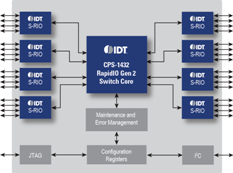
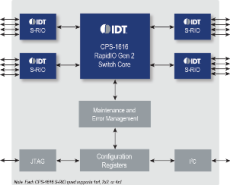
| RioSwitch | RapidIO Gen2 | Tundra's RapidIO® Gen2 program builds on our industry-leading RapidIO Rev 1.3 Solutions, currently in volume production in WiMAX, 3G, video and military applications. Tundra's RapidIO Gen2 products will include switches and Intellectual Property (IP) for endpoints such as DSPs, Microprossesors, FPGAs and ASICs. | ![]() |
||||
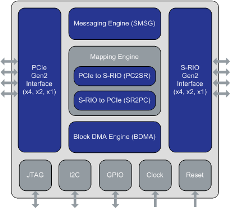
| RioSwitch | Tsi620 | The Tundra Tsi620™ is the latest offering in Tundra’s industry-leading family of RapidIO devices. The Tsi620 provides the functionality of both a RapidIO switch and a non-transparent RapidIO-to-PCI bridge. The RapidIO switch offers 50 Gbps aggregate bandwidth, while the RapidIO-to-PCI bridge enables legacy systems to link to the high-bandwidth RapidIO interconnect. The Tsi620 contains all the benefits of Tundra's family of RapidIO switches and adds interfaces to PCI-enabled processors, as well as an interface to low-cost FPGAs. The RapidIO switch offers up to three 10 Gbps ports as well as a port for 10 Gbps RapidIO over an XGMII physical interface. The device can be used to connect clusters of DSPs and microprocessors required for high performance embedded computing applications, such as wireless baseband 3G LTE, WiMAX, and wideband CDMA systems. It can also be used in wireline networking, video, and military applications to reduce cost while increasing performance. Alternatively, one or more ports from the RapidIO switch can be used for backplane or front panel connectivity. This FPGA port on the RapidIO switch permits the use of the Tsi620 with low-cost non-SerDes FPGA, or eliminates a discrete SerDes from the system, substantially reducing system-level cost. The RapidIO-to-PCI bridge enables legacy systems to link to DSP clusters through the high-bandwidth RapidIO Switch. By leveraging the PCI-to-RapidIO bridging capability, system OEMs are able to use competitively priced embedded processors, while leveraging the investment in existing embedded software. |
![]() |
||||
| RioSwitch | Tsi578 | The Tsi578™ is Tundra’s third-generation Serial RapidIO Switch. Supporting 80 Gbps aggregate bandwidth, the Tsi578 enables customers to develop high performance systems at low cost. The device is targeted at the following:
The Tsi578 can be configured as a 16-port x1 switch or an 8-port x4 switch (or various combinations of x1 and x4). Each of the ports can operate at 1.25 Gbaud, 2.5 Gbaud, or 3.125 Gbaud. |
![]() |
||||
| RioSwitch | Tsi577 | The Tundra Tsi577™ is a fifth-generation RapidIO switch. The Tsi577 supports 40 Gbps aggregate non-blocking bandwidth at lower power than previous RapidIO switches. Using the Tsi577, flexible port configurations can be selected through multiple port width and speed options. The Tsi577 can be configured as a 16-port x1 mode switch or a 4-port x4 mode switch (or various combinations of x1 and x4 modes). Each port on the device can be a single x4 mode port or four x1 mode ports and can operate at 1.25 Gbaud, 2.5 Gbaud, or 3.125 Gbaud (or any speed in between on a quad grouping basis). |
![]() |
||||
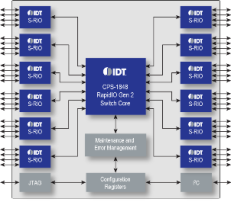
| RioSwitch | Tsi576 | The Tsi576™ is part of Tundra’s third-generation RapidIO® switch family. Supporting 40 Gbps aggregate bandwidth, the Tsi576 enables customers to develop high performance systems at low cost. The device is targeted at chip-to-chip DSP and processor aggregation and connection to network/backplane uplinks. The Tsi576 can be configured as a 12-port x1 switch or a two-port x4 plus eight x1-port switch (or various combinations of x1 and x4). In the “eight plus two” configuration, the two-port x4 are used to aggregate traffic from local DSP or processor clusters serviced by the up to eight x1-ports. Each of the ports can be run at 1.25 Gbaud, 2.5 Gbaud, or 3.125 Gbaud. |
![]() |
||||
| RioSwitch | Tsi574 | The Tsi574™ is part of Tundra’s third-generation RapidIO switch family. Supporting 40 Gbps aggregate bandwidth, the Tsi574 enables customers to develop high performance systems at low cost. The device is targeted at chip-to-chip DSP and processor aggregation. The Tsi574 can be configured as an 8-port x1 switch or a 4-port x4 switch (or various combinations of x1 and x4). Each of the ports can be run at 1.25 Gbaud, 2.5 Gbaud, or 3.125 Gbaud. |
![]() |
||||
| RioSwitch | Tsi572 | The Tundra Tsi572™ is a third-generation RapidIO switch that supports 30 Gbps aggregate bandwidth and is optimized for multiprocessor, peer-to-peer embedded networking using the RapidIO Interconnect Specification (Revision 1.3). The Tsi572 offers lower power and cost-per-gigabit switched than equivalent PCIe and GigE solutions, making it optimal for cost sensitive, power-limited embedded systems. For cost sensitive designs, the socket compatibility between the Tsi572 and Tsi576 enables customers to cost-reduce certain Tsi576 applications. | ![]() |
||||
| RioSwitch | Tsi568A | The Tundra Tsi568A™ is a second-generation RapidIO switch. Supporting 80 Gbps aggregate bandwidth, the Tsi568 enables customers to develop high performance systems at low cost. The Tsi568A can be configured as a 16-port x1 switch or an 8-port x4 switch (or various combinations of x1 and x4). Each of the ports can be run at 1.25 Gbaud, 2.5 Gbaud, or 3.125 Gbaud. |
![]() |
||||
| RioSwitch | Tsi564A | The Tsi564A™ is part of Tundra’s family of second-generation RapidIO switches. Supporting 40 Gbps aggregate bandwidth, the Tsi564 enables customers to develop high performance systems at low cost. The Tsi564 is targeted at chip-to-chip DSP and processor aggregation and comes in a small 21 mm x 21 mm package size. The Tsi564A can be configured as a 8-port x1 switch or an 4-port x4 switch (or various combinations of x1 and x4). Each of the ports can be run at 1.25 Gbaud, 2.5 Gbaud, or 3.125 Gbaud. |
![]() |
||||
| RioTool | Tundra RapidIO Power Calculator | The Tundra RapidIO Power Calculator provides switch power consumption under various conditions. This provides an application specific view of power by taking into account the specific configuration of the switch. The tool enables power to be determined for various combinations of link speeds (3.125, 2.5, 1.25 Gbaud), lane configurations (4x, 1x), and port counts used on a specific Tundra switch. The tool also can estimate power based on non-standard RapidIO rates or varying traffic conditions. |
|||||
| RioTool | Tundra RapidIO System Modeling Tool | The RapidIO System Modeling Tool delivers fast answers to architectural questions about RapidIO system performance. Any system topology can be modeled, including large systems with hundreds of switches and endpoints. Traffic flows are specified using a rich syntax that allows users to define the model to its level of design maturity. Users can specify traffic flow start/stop relationships that enables detailed modeling of data transfers in systolic processing algorithms. | |||||
| RioTool | Tundra Signal Analyzer | The Tundra family of RapidIO Switches enable a system-level diagnostic capability using features built into the SerDes on RapidIO ports. The quality of the RapidIO link connected between Tundra switches, or between a Tundra switch and a compatible endpoint, can be analyzed with the RapidIO Signal Analyzer. This tool enables the system OEM to view the quality of the serial signal as seen on the actual die through a hardware component, the Tsi574™ Link Partner Card (LPC); and a software component, the On-chip Scope diagnostic software (OCS). These components of the RapidIO Signal Analyzer work together to provide signal visibility and to analyze link integrity in Tundra RapidIO based designs. |
![]() |
||||
| VMEBridge | TSi148 | The Tundra Tsi148™ is the highest bandwidth VME bridge available, providing PCI-X-to-VME 2eSST performance levels while maintaining backward compatibility with older standards. As the VME chassis continues to evolve, Tsi148 provides the bandwidth required to connect together distributed computing elements. VME systems are using distributed processing elements like CPUs, NPUs, and DSPs in order to manage the thermal density and provide scalability. New standards like VXS and VPX are using RapidIO® interconnect as the data path but in parallel VME bus traffic will also increase because control plane bandwidth scales with data bandwidth. |
![]() |
||||
| VMEBridge | Universe IID | The Universe™ IID (also known as Universe II) is the industry standard PCI-to-VME bridge. Bridging is accomplished via a powerful decoupled architecture with independent FIFOs for inbound, outbound, and DMA traffic. With this architecture, throughput is maximized without sacrificing bandwidth on either bus. Universe bridges between the VME 64-bit bus to either a 32- or 64-bit PCI bus at 33 MHz. A zero-wait state implementation, with multi-beat transactions and support for bus parking, ensure that the Universe II is never the bottleneck on the PCI bus. On the VME interface, a rich set of features ensures that the device fits within a wide range of applications. A full suite of addressing and data modes is implemented, including BLT and MBLT support. In addition, a fully featured system controller, interrupter, interrupt handler, and Linked-List DMA make the Universe II a flexible System Interconnect device. |
![]() |
||||
eval RioSwitch |
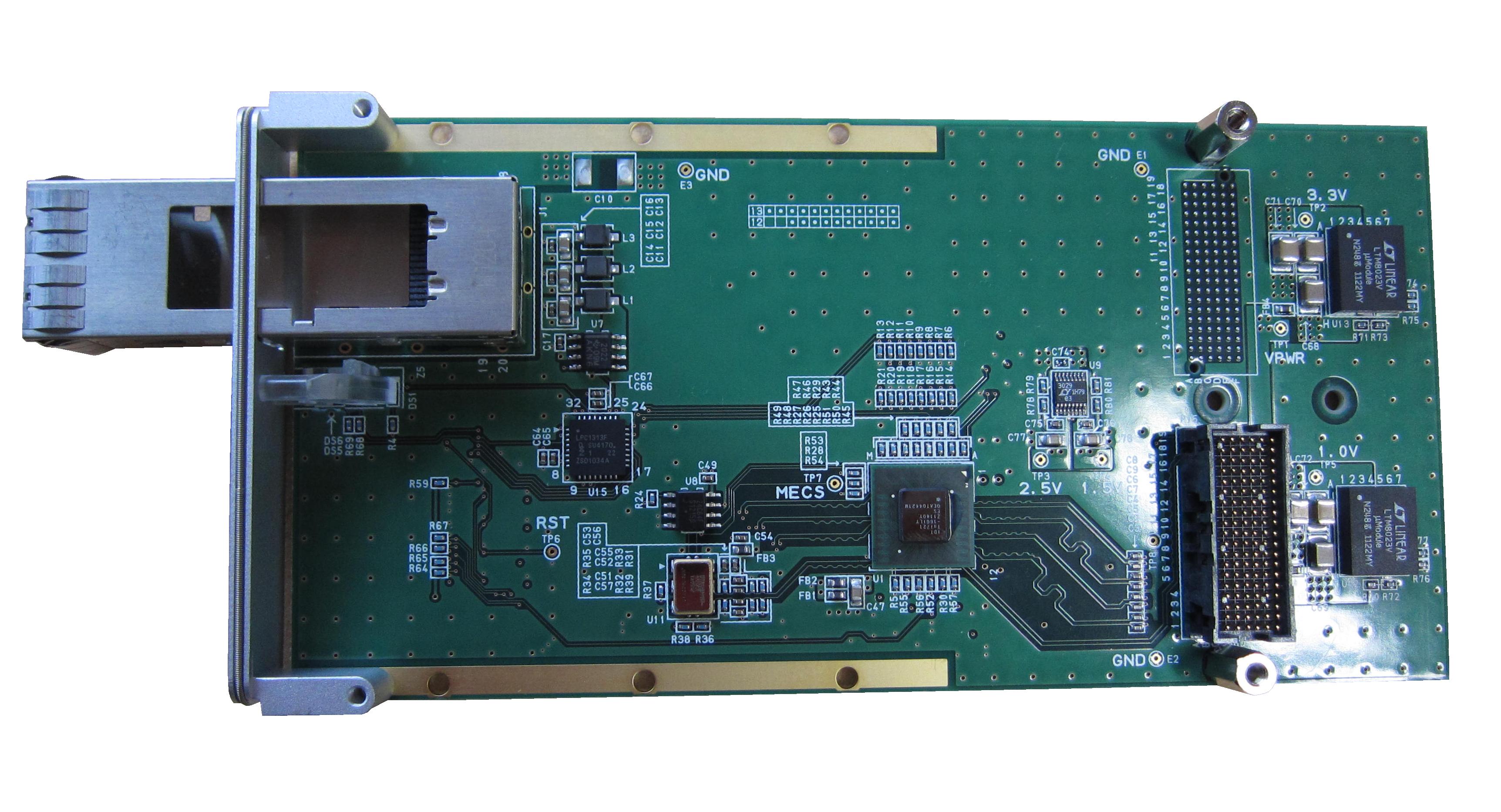
Tsi620 Evaluation Board | The Tundra Tsi620 Evaluation Board (EVB) is an AMC width card that enables system OEMs to develop applications that use the Tsi620 Multi-protocol RapidIO Switch. The EVB can be used in a MicroTCA chassis or standalone. | ![]() |
||||
eval PCIeBridge |
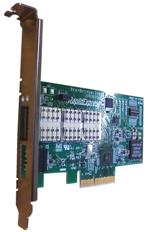
Tsi384 Evaluation Board | The Tundra Semiconductor Tsi384 evaluation board is ideal for evaluating and prototyping the Tsi384 PCIe-to-PCI bridge. The Tsi384 evaluation board is an extended height x4 PCIe card that is designed to fit into a standard PCIe slot on a PC motherboard, or interconnect with other cards equipped with a standard PCIe connector. | ![]() |
||||
eval PCIeBridge |
Tsi382 Evaluation Board | The Tundra Semiconductor Tsi382 evaluation board is ideal for evaluating and prototyping the Tsi382 PCIe-to-PCI bridge. The Tsi382 evaluation board is an extended height x1 PCIe card that is designed to fit into a standard PCIe slot on a PC motherboard, or interconnect with other cards equipped with a standard PCIe connector. | ![]() |
||||
eval PCIeBridge |
Tsi381 Evaluation Board | The Tundra Semiconductor Tsi381 evaluation board is ideal for evaluating and prototyping the Tsi381 PCIe-to-PCI bridge. The Tsi381 evaluation board is an extended height x1 PCIe card that is designed to fit into a standard PCIe slot on a PC motherboard, or interconnect with other cards equipped with a standard PCIe connector. | ![]() |
||||
| TsiView for PCIe | TsiView is a Windows-based tool for accessing Tundra’s PCIe device registers. The main function of the tool is to offer customers a user-friendly environment for viewing and optimizing the register settings of Tundra’s PCIe devices. In addition, TsiView can be used to program serial EEPROM devices with register settings that are optimized by the tool. | ![]() |